







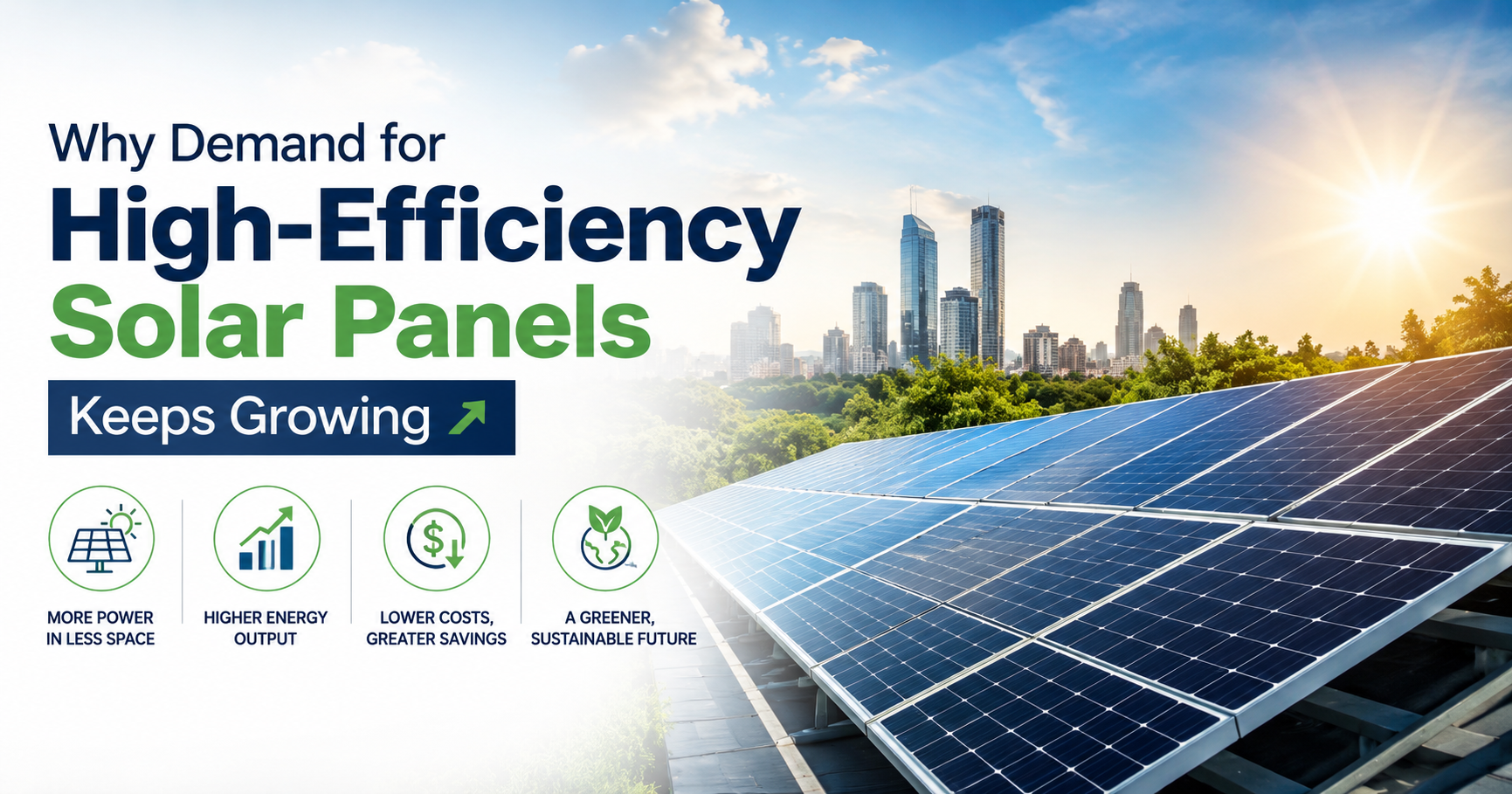
Why Demand for High-Efficiency Solar Panels Keeps Growing

Walk through any American neighborhood today and you will notice something that was rare just a decade ago: solar panels on nearly every other rooftop. Drive past commercial warehouses, schools, and farms, and the story is the same. Solar has gone from niche to mainstream with remarkable speed. But within that broader solar boom, a more specific trend is accelerating — buyers are not just choosing solar, they are choosing better solar. Demand for high-efficiency panels is rising faster than the overall market, and the reasons why reveal a great deal about where energy technology and consumer priorities are headed.
What “High-Efficiency” Actually Means
Efficiency in a solar panel refers to the percentage of sunlight that strikes the panel’s surface and gets converted into usable electricity. A standard panel might convert 17–19% of incoming solar energy. A high-efficiency panel — typically using advanced monocrystalline silicon or emerging technologies like TOPCon (Tunnel Oxide Passivated Contact) and heterojunction (HJT) cells — can achieve 21–24% or higher.
That difference may sound modest in percentage terms. In practice, it is transformative. A high-efficiency panel generates meaningfully more electricity from the same surface area, which changes the economics, the design options, and the long-term value of an installation in ways that matter deeply to buyers.
Space Is the Constraint That Drives the Choice
For most residential solar buyers, roof space is limited. There is only so much usable, unshaded area facing the right direction. In this context, efficiency becomes a decisive factor — not a luxury.
A homeowner in California or New Jersey with a smaller south-facing roof who wants to offset a large electricity bill has two options: install fewer standard panels and fall short of their energy goals, or install high-efficiency panels in the same space and get the output they need. For millions of American homeowners, the choice is straightforward.
The same logic applies to commercial installations on warehouses, retail buildings, and industrial facilities where rooftop real estate is finite but energy demand is high. High-efficiency panels allow system designers to maximize generation from available space without expanding the footprint of the installation.
Rising Electricity Costs Make Every Kilowatt-Hour Count
Retail electricity rates across the United States have been climbing. In states like California, Massachusetts, Connecticut, and Hawaii, residential electricity prices have reached levels that make the return on solar investment exceptionally compelling. But rising rates also intensify the premium on performance — the more expensive grid electricity is, the more valuable every additional kilowatt-hour your system generates becomes.
High-efficiency panels generate more electricity over their lifetime. That additional output, multiplied across twenty-five or more years of system life, can represent thousands of dollars in additional savings compared to a standard-efficiency installation of the same physical size. For buyers doing the math carefully — and in 2026, most buyers are — high-efficiency panels win the long-run calculation.
Technology Advances Have Narrowed the Price Gap
For years, high-efficiency panels commanded a price premium that put them out of reach for cost-sensitive buyers. That dynamic has shifted considerably. Manufacturing advances, scale, and competition among leading panel producers have brought the price premium for high-efficiency technology down to a level where the cost-per-watt difference is often offset within a few years by the additional generation output.
TOPCon and HJT panel technologies, in particular, have moved from premium curiosities to mainstream products offered by major manufacturers. The value equation for buyers has changed: you pay slightly more upfront, but you generate more electricity for the full life of the system. For most buyers with a long-term perspective — which describes virtually anyone making a twenty-five-year energy infrastructure decision — that trade-off is favorable.
Temperature Performance and Durability Matter in the Real World
High-efficiency panels tend to outperform standard panels in real-world conditions beyond just their headline efficiency rating. Two factors stand out:
Temperature coefficient. All solar panels lose some efficiency as they heat up. High-efficiency panel technologies, particularly HJT, have lower temperature coefficients — meaning they hold their performance better on hot summer days when solar generation is most valuable and grid demand is at its peak.
Degradation rate. Premium high-efficiency panels degrade more slowly over time, meaning the performance gap between a high-efficiency system and a standard one actually widens as the years pass. A panel that degrades at 0.3% annually rather than 0.5% annually will produce noticeably more electricity by year fifteen or twenty.
For buyers thinking about the full twenty-five-to-thirty-year lifespan of their system, these real-world performance factors carry significant weight.
The Bottom Line
Demand for high-efficiency solar panels keeps growing because buyers are getting smarter. They are looking beyond the upfront sticker price and evaluating lifetime energy production, space utilization, long-term performance, and total return on investment. When you run those numbers, high-efficiency technology makes a compelling case.
In a market where electricity prices are rising, roof space is finite, and solar technology is rapidly advancing, choosing the most capable panels available is not overcautious — it is the rational decision. The buyers driving this demand surge are not chasing the latest trend. They are making one of the most financially sound energy investments available to American homeowners and businesses today.