







How Microinverters Improve Solar Performance in Complex Roof Layouts

Not every roof is a solar installer’s dream. The ideal installation — a large, unobstructed, south-facing surface with no shade, no dormers, and a perfect pitch — describes only a fraction of American homes. The reality for most homeowners is a roof with multiple angles, chimneys, skylights, vents, or nearby trees that cast shadows at certain times of day. For years, these complex roof layouts significantly limited what solar could deliver. Today, microinverter technology has changed that equation entirely.
If you have been told your roof is “too complicated” for solar, or if you have received a solar proposal that seemed to underperform relative to your electricity bills, understanding how microinverters work — and why they outperform traditional string inverter systems on challenging roofs — could completely change your perspective on what solar can do for your home.
The Problem With Traditional String Inverters on Complex Roofs
To understand why microinverters matter, you first need to understand how conventional string inverter systems work — and where they fall short.
In a traditional string inverter system, multiple solar panels are wired together in a series, called a string, and connected to a single central inverter. That inverter converts the combined DC output of all the panels into usable AC electricity for your home.
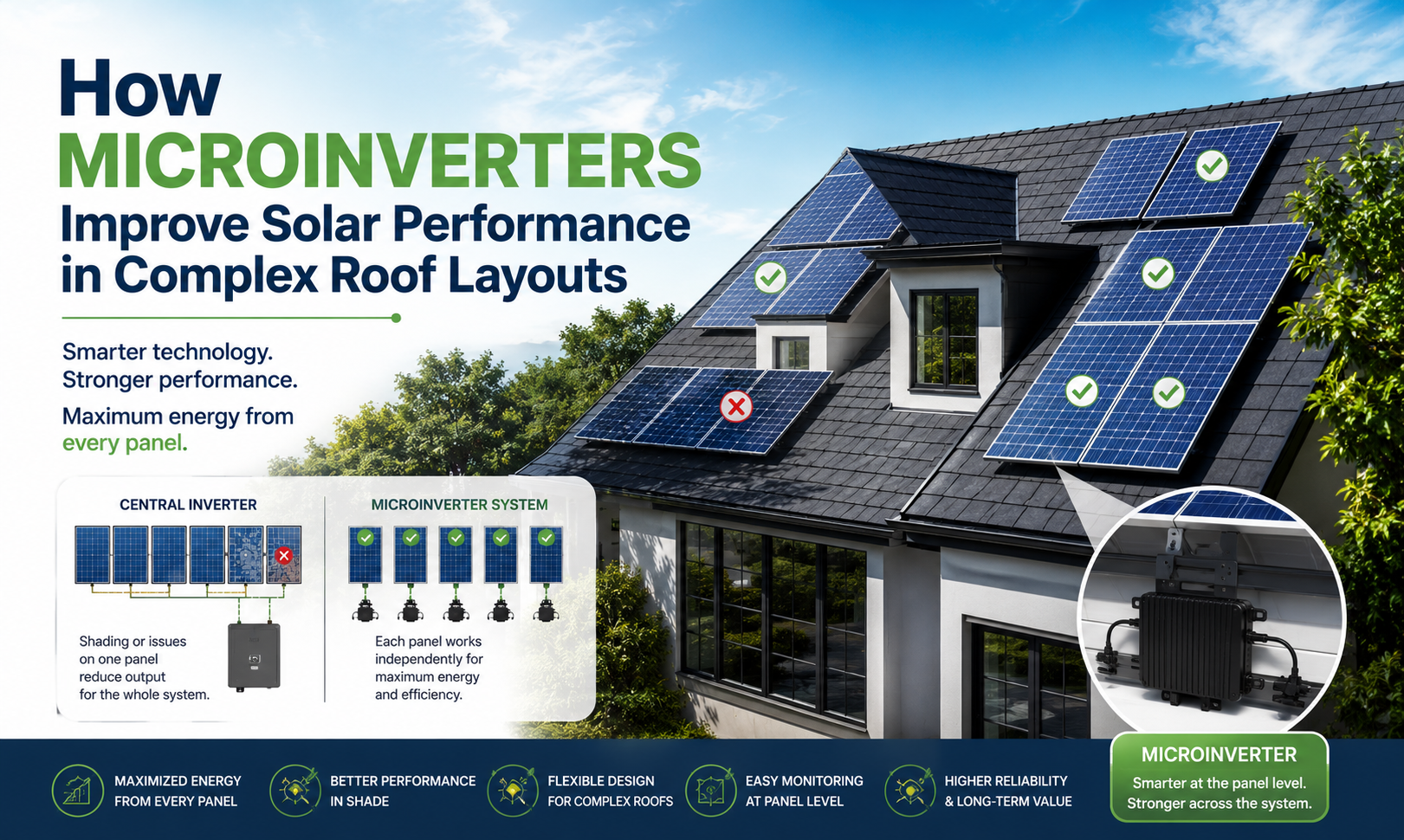
The critical weakness of this design is what engineers call the Christmas light effect. In a series string, the performance of the entire string is limited by the weakest panel. If one panel is partially shaded by a chimney shadow at noon, or covered by leaves, or simply oriented differently from the others, it drags down the output of every other panel on that string — even those in full, direct sunlight.
On a simple, unobstructed roof with all panels facing the same direction, this limitation rarely matters. On a complex roof with multiple faces, varying orientations, and shading from trees or rooftop features, it can cause dramatic underperformance — sometimes reducing total system output by 20–30% or more compared to theoretical maximum.
What Microinverters Do Differently
A microinverter is a small inverter mounted directly on — or integrated into — each individual solar panel. Instead of converting the combined output of many panels at once, each microinverter independently converts the DC output of its own single panel into AC electricity right at the source.
This architectural difference has profound consequences for performance on complex roofs:
Panel-Level Independence. Because each panel operates independently, a shaded or underperforming panel has zero effect on its neighbors. A chimney shadow falling across two panels at midday affects only those two panels — the other fourteen on your roof continue generating at full capacity. On a string system, all sixteen panels would be compromised.
Optimized Output From Every Orientation. Many complex roofs have panels on south-facing, east-facing, and west-facing surfaces simultaneously. On a string system, mixing panel orientations creates inevitable conflicts — the inverter cannot optimize for all of them at once. With microinverters, each panel is individually optimized regardless of which direction it faces, allowing multi-orientation installations to perform far closer to their theoretical potential.
Maximum Power Point Tracking Per Panel. Every microinverter continuously performs its own Maximum Power Point Tracking (MPPT) — the process of finding the optimal voltage and current combination to extract maximum power from that specific panel under current conditions. On a complex roof where different panels experience different shading and irradiance levels throughout the day, panel-level MPPT is the difference between good performance and exceptional performance.
Real-World Impact: What the Numbers Show
The performance advantage of microinverters over string inverters on complex roofs is not theoretical — it shows up in measured energy production data.
Studies and field measurements consistently show that microinverter-based systems on shaded or multi-orientation roofs produce significantly more energy than equivalent string inverter systems. In cases of moderate shading or multiple roof faces, the production advantage can range from 5% to 25% more annual energy generation. Over a twenty-five-year system life, that difference in kilowatt-hours translates directly into thousands of dollars in additional savings.
For homeowners in high-rate states like California, Massachusetts, or New York — where electricity costs more per kilowatt-hour — the financial value of that additional production is even greater.
Monitoring: Know Exactly What Every Panel Is Doing
Beyond raw performance, microinverters offer a monitoring advantage that string systems simply cannot match.
With a microinverter system, every panel reports its own performance data in real time to a monitoring platform accessible from your phone or computer. If a single panel develops a fault, accumulates debris, or underperforms for any reason, the monitoring system identifies it immediately and precisely — down to the exact panel on your roof.
On a string system, monitoring shows total system output. A single underperforming panel can go undetected for months, quietly costing you energy production without any visible alert.
Enphase Energy’s IQ8 microinverter platform, one of the leading systems in the U.S. market in 2026, provides panel-level monitoring through the Enphase App — giving homeowners complete, real-time visibility into the performance of every panel on their roof. Installers can also access detailed diagnostic data remotely, reducing the need for on-site service visits.
Safety: An Underappreciated Advantage
Microinverter systems carry a safety advantage worth understanding, particularly for homeowners, first responders, and installers.
In a string inverter system, high-voltage DC electricity — potentially 600 volts or more — runs through conduit across your roof and into your home. In an emergency such as a house fire, that energized DC wiring presents a serious hazard to firefighters.
Microinverter systems convert DC to AC at each panel, meaning only standard AC voltage travels through the home’s wiring. Many fire departments and building officials specifically prefer microinverter systems for this reason, and some jurisdictions have moved toward requiring rapid shutdown capabilities that microinverter architectures naturally provide.
Is a Microinverter System Right for Your Roof?
Microinverters are the strongest choice for any home with:
- Shading from trees, chimneys, dormers, or neighboring structures at any point during the day
- Multiple roof faces at different orientations (south, east, and west panels in the same system)
- A roof layout that requires panels to be installed on non-ideal surfaces
- A homeowner who values panel-level monitoring and precise performance data
- Plans to expand the system in the future, since microinverters make it simple to add individual panels without redesigning the string configuration
For very simple, large, unobstructed roofs with all panels facing the same direction and no shading concerns, a high-quality string inverter may deliver comparable performance at a slightly lower upfront cost. But for the complex, real-world roofs that most American homeowners actually have, microinverters are not just a better option — they are often the only option that fully unlocks the roof’s solar potential.
The Bottom Line
Complex roofs used to be a legitimate barrier to high-performing solar. Microinverter technology has dismantled that barrier. By giving every panel its own independent inverter, eliminating the Christmas light effect, enabling multi-orientation optimization, and providing panel-level monitoring and safety benefits, microinverters turn difficult roofs into productive ones.
If your roof has ever been described as complicated, shaded, or suboptimal for solar, the right conversation is not whether you can go solar — it is whether your installer is proposing the right technology to make your roof perform. In 2026, that technology is mature, proven, and more accessible than ever.
Every panel on your roof has the potential to perform at its best. Microinverters make sure it does.